Asphalt milling also known as cold milling, cold planing, or pavement profiling is a specialized pavement restoration technique that plays a key role in maintaining roads, driveways, and parking lots across Avoca, Pennsylvania and the broader Northeastern Pennsylvania region. Unlike resurfacing, which simply adds material on top of existing pavement, milling removes the worn or damaged surface layer before a new overlay is applied. The result is a pavement structure that maintains proper elevation relationships, drainage function, and structural integrity and does so more cost-effectively than full-depth replacement.
What Asphalt Milling Actually Does
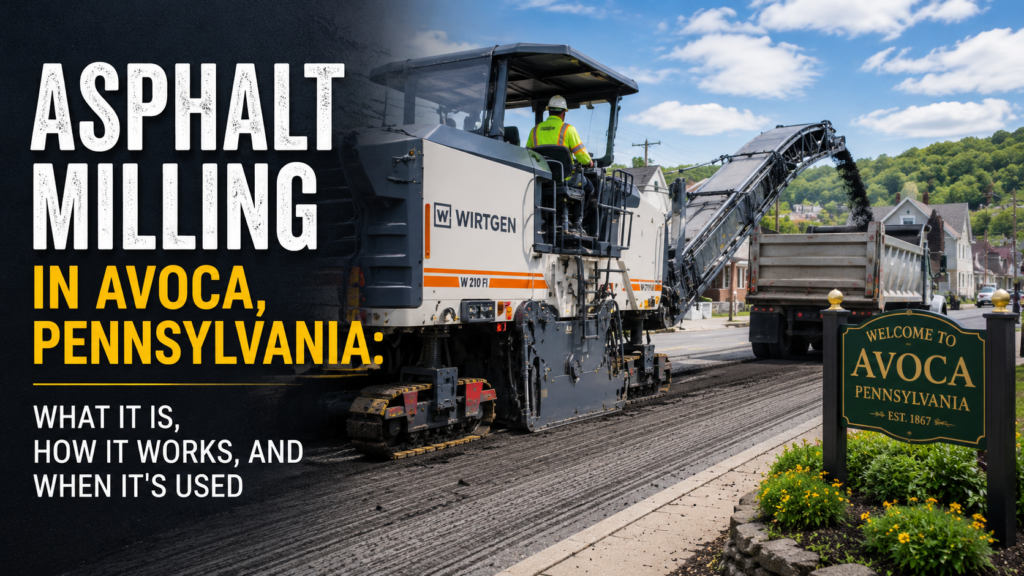
Asphalt Milling Avoca is the process of using a specialized cold planer machine a powerful piece of construction equipment equipped with a rotating drum studded with carbide cutting teeth to grind away the existing asphalt surface to a specified depth. The milling machine moves forward at a controlled pace while the drum cuts the asphalt into small fragments called millings, which are conveyed directly onto a haul truck running alongside the machine.
The precision of modern milling equipment is remarkable. Laser and string-line guidance systems allow operators to control milling depth to within fractions of an inch, maintaining consistent surface profiles across large areas. Cross-slope corrections can be made by adjusting the drum angle, allowing contractors to modify the drainage profile of a paved surface while removing the old wearing course.
Why Milling Is Necessary Before Many Overlays
A question property owners frequently ask is why milling is necessary before resurfacing when it seems simpler to just pave over the existing surface. There are several technical reasons why milling is the correct approach in many situations:
- Height constraints: Each overlay adds thickness to the pavement surface. If a parking lot has been overlaid multiple times, the surface is already significantly higher than it was originally. Further overlays without milling would raise the surface above curbs, drain inlet frames, garage door thresholds, and other fixed elevation references. Milling removes the equivalent depth of what the new overlay will add, maintaining these critical height relationships.
- Improved adhesion: The textured surface left by the milling drum provides better mechanical bonding for the new asphalt overlay than a smooth, possibly contaminated existing surface. This improves the structural performance and longevity of the overlay.
- Drainage correction: Milling allows the contractor to modify the cross-slope of the existing surface for example, correcting a crowned section that has lost its drainage profile, or adjusting a lot that has settled unevenly. These corrections cannot be made by simply adding material on top.
- Removal of deteriorated material: When the existing wearing course is extensively cracked, oxidized, or contaminated, milling removes this problematic material and replaces it with fresh, correctly specified asphalt.
The Milling Process Step by Step
A milling project in Avoca follows a defined sequence:
- Pre-milling assessment: The contractor assesses the area to confirm milling depth and any special requirements adjusting drum angle for cross-slope correction, identifying areas needing additional depth for base repair.
- Milling machine operation: The cold planer is positioned at the starting edge, drum depth is set, and the machine begins cutting. A continuous stream of millings flows up the conveyor onto haul trucks.
- Water application: Water is continuously sprayed on the drum during operation to cool the carbide teeth and suppress dust. This is why milling operations create a visible water mist around the equipment.
- Milling pattern management: Cuts are made in overlapping passes to cover the entire area to the specified depth. Edge transitions at the borders of the milled area are carefully managed to create appropriate transitions for the new overlay.
- Millings hauling: Haul trucks continuously receive millings and transport them to the recycled asphalt pavement (RAP) processing facility.
- Surface preparation: The milled surface is swept clean of fine material before the overlay is applied.
Recycled Asphalt Millings: An Environmental and Economic Benefit
One of the most significant advantages of asphalt milling is that the removed material the millings is not waste. Reclaimed asphalt pavement (RAP) is one of the most recycled materials in the United States. The millings are processed at asphalt plants and reintroduced as a portion of the aggregate and binder content of new hot mix asphalt. This recycling reduces the demand for virgin aggregate and petroleum-based binder, lowering both the cost and the environmental footprint of new pavement production.
The use of RAP in new asphalt mixes has been recognized and standardized by the Federal Highway Administration and is widely practiced throughout Pennsylvania. For property owners in Avoca, this means that the material removed from their pavement during milling is not sent to a landfill but is productively reused a meaningful sustainability outcome from what might otherwise seem like a purely destructive operation.
Applications of Asphalt Milling in Avoca
Milling is used across a range of pavement types and project contexts in Avoca and the broader Lackawanna-Luzerne area:
- Commercial parking lot restoration: Lots that have been overlaid multiple times and need surface renewal without compromising curb heights or drain inlet frames.
- Road rehabilitation: Municipal and county roads undergoing planned maintenance cycles use milling to remove the worn wearing course before a new lift is applied.
- Residential driveway renovation: Driveways where the garage apron height or public sidewalk grade would be compromised by another overlay without first milling down.
- Surface profile correction: Areas where ponding water or poor drainage indicate that the current surface grade needs to be adjusted.
Conclusion
Asphalt milling in Avoca is a precision pavement engineering service that enables cost-effective surface renewal while maintaining the functional design relationships that make pavement work correctly drainage, height at curbs and inlets, and structural integrity. Understanding what milling is, why it is specified in certain project conditions, and what the recycled material enables gives property owners the technical context to evaluate contractor recommendations and recognize when milling is the right approach for their pavement restoration project.